
Data Center & Cabling Solutions in DC, MD, VA, NC, & SC
North Carolina Structured Cabling Installation
Since 1986, NPI Connect has been the trusted infrastructure and intelligent building partner for government, healthcare, legal, and commercial clients across the Mid and South Atlantic. We design smart, sustainable environments that perform today and scale for tomorrow.
Backbone Cabling and Cabling Connector Needs
Options for Structured Cabling Installation NC Companies Need to Consider
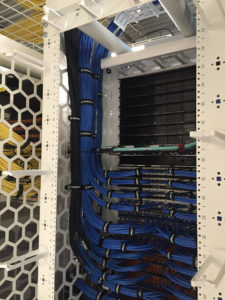 When installing a structured cabling system, there are many facets to consider in the design of this telecommunications network. Plans for cabling vary among companies, depending on their needs and the building architecture. Here, we have focused on two important components of structured installations: cabling connectors and backbone cabling. A specialist from Network Products, Inc. can provide you with more information about structured cabling installation in NC that is right for your office, workspace, or company property.
Backbone Cabling
Backbone cabling consists of two kinds of cables: inter-building and intra-building. The term backbone refers to the cables that handle the major flow of network traffic. From the entrance facility, a structured cabling network can branch outwards to nearby buildings and connect floors. Backbone cabling can help strengthen and transfer telecommunication to various areas of your company’s building.
Function and Connections
The function of backbone cabling is to support connections between telecommunication closets, entrance facilities, and equipment rooms. The components of a backbone system can include intermediate cross-connects, mechanical terminations, main cross-connects, patch cords, jumpers, and backbone cables. When talking about structured cabling installation in NC, the definitions of intra- and inter-building backbone cabling are defined as follows:
- Inter-building: these backbone cables handle traffic between different buildings.
- Intra-building = these backbone cables handle traffic that flows between closets within one single building.
There are a few main components that make up a backbone cabling system, and are briefly described below:
- Pathway for cables: includes raceways, conduits, shafts, floor penetrators (sleeves, slots) that offer sufficient cable routing space.
- Backbone cables: twisted-pair copper, coaxial copper, optical fiber, or a mixture of all.
- Connective hardware: patch panels, connective blocks, interconnections, cross-connections or a combination.
- Support facilities: firestopping, grounding hardware, and cable support.
Cabling Connectors
This is a mechanical device used to connect a cable to equipment or to connect different cables to each other. The goal of cabling connectors is to provide a way to couple mechanisms without incurring high costs. Fiber and copper both permit signals to move from one connector to another. Copper handles electrical signals, while fiber handles light impulses. For a connection to be efficient, it may require aligning connectors, preventing separation, and ensuring proper transmission of electricity or light.
Connectors can be as essential to the foundation strength of an entire telecommunications network as the backbone cabling. Connectors enable alignment and attachment of media to a transmitter, telecommunications device, media, or receiver. Structured cabling installation in NC can be simplified when you hire Network Products, Inc. to do the job.
Contact Us Today
The details surrounding cabling and connectors within a structured system can get complicated and tricky. A specialist from Network Products, Inc. can answer any questions you may have and offer recommendations based on your company’s needs. Please do not hesitate to contact us to schedule an appointment. We would be more than happy to hear how we can assist with your telecommunications infrastructure needs. When it comes to structured cabling installation NC companies rely on us for a reason. We are a team of friendly and skilled professionals who take pride in helping improve the efficiency of a work environment and increase a company’s efficiency.
Recent Client Reviews

“NPI took the time to fully understand our operational requirements and long-term goals before developing our infrastructure plan. Their team provided clear, practical design documentation that helped us make informed decisions and move forward with confidence. The process was well organized, and the solutions delivered were reliable, scalable, and aligned with our environment.”