Smart building technology design and integration, grounded in infrastructure planning since 1986.
If rising energy bills, aging controls, and disconnected systems are disrupting your business, building improvements can make a meaningful difference. Smart building design lowers what a property costs to operate and makes it a more comfortable working environment. Network Products Inc has planned and specified smart building technology for owners, developers, and facility managers since 1986. We bring BICSI RCDDs and LEED APs on staff, along with a designer’s perspective of asking what a building will need five years from now. Reach out to discuss your project.
What Smart Building Technology Actually Is
Smart building technology connects a building’s core systems so they share information and respond together. Lighting, HVAC, power, access control, and life-safety stop running as separate islands. They sit on a shared network, fed by sensors and software that track how the space is really used.
The payoff is visibility and control. A connected building can dim lights in empty rooms, pull back ventilation after hours, flag a failing part before it quits, and lock down a door the moment it needs to. Intelligent building systems take a static structure and make it responsive.
Smart buildings come in degrees. Some are wired for everything from day one. Others start with a single upgrade and grow from there. You do not have to automate the whole property to see a return on investment, and an older infrastructure is rarely the obstacle people expect. With the right network in place, a decades-old building can run on the same connected logic as new construction.
Smart Building Technology Services We Offer
We are a planning and design firm first. Network Products Inc works upstream, before a single cable gets pulled, mapping the systems a building needs and the products that fit it. The mix changes from one building to the next, but the planning discipline behind it does not. Our work on a connected building usually covers these areas:
- Smart building systems. We design the integrated backbone that ties lighting, HVAC, access, and sensors into one network. The goal is a building whose parts cooperate instead of working blind.
- Smart building solutions. A retrofit and a ground-up build call for different choices. We match the right mix of automation to your goals, your building, and your budget.
- Intelligent building design. Using Revit, AutoCAD, and Visio, we produce drawings and specifications a contractor can build from without guesswork. The documentation doubles as a roadmap for future expansion.
- Cabling solutions. Structured cabling is the nervous system of any smart building. We plan and specify cabling that carries today’s load and has room for tomorrow’s.
- Data centers. The computer behind building automation has to live somewhere dependable. We design data center infrastructure built for enterprise, healthcare, and government demands.
- A/V solutions. Displays, sound, and collaboration tools shape the daily occupant experience. We integrate audio and video that works on the first try.
- Meeting rooms. We design connected rooms and open work areas where booking, screens, and controls behave. People should be able to start a meeting, not troubleshoot one.
- Smart lighting solutions. Networked and PoE lighting cuts energy use and doubles as an occupancy sensor layer. Fixtures become a source of data, not just light.
- Internet of Things. Sensors for occupancy, temperature, and air quality give a building the raw information it runs on. We plan deployments that produce signal, not noise.
- Design assist services. We join architects, contractors, and owners early so technology decisions don’t turn into costly surprises during construction.
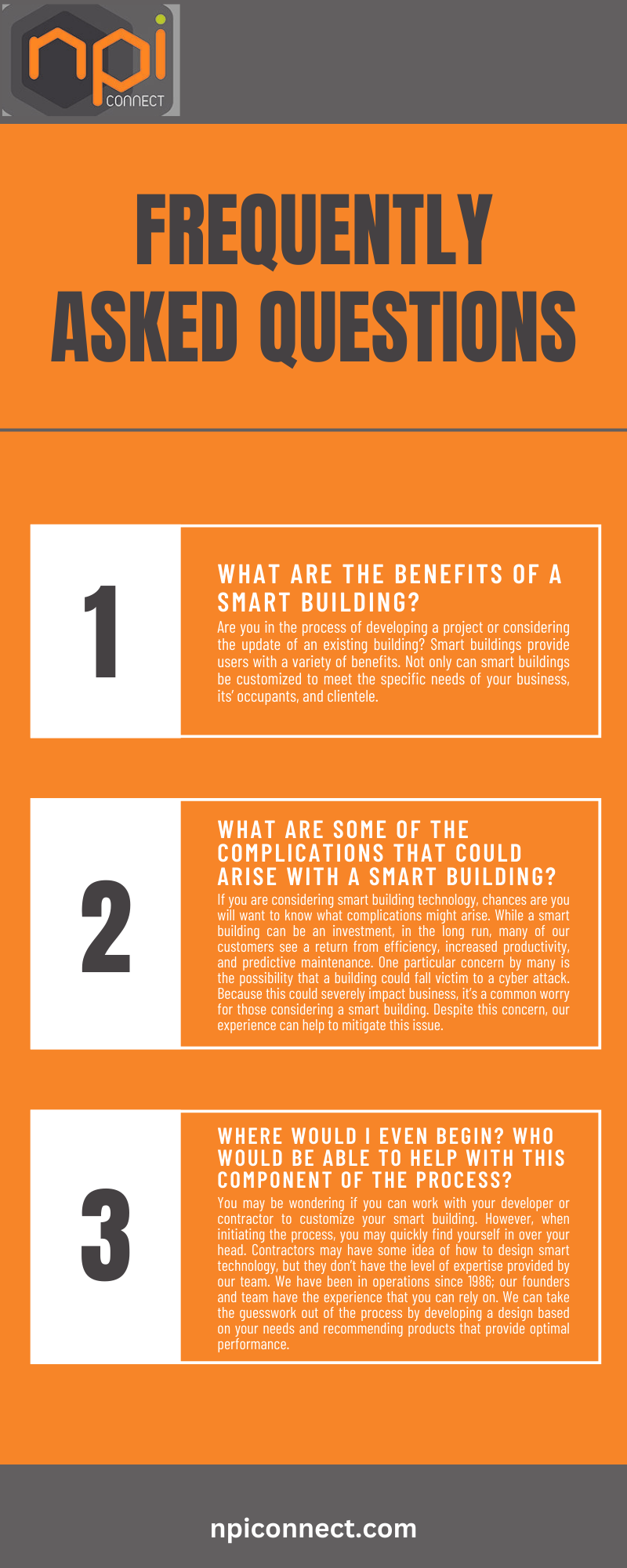
FREQUENTLY ASKED QUESTIONS INFOGRAPHIC
Why Choose Network Products Inc for Smart Building Technology
We have planned building infrastructure since 1986, and we are the largest and most technically diverse manufacturer’s representative organization in the Mid Atlantic. Because we represent a broad range of manufacturers, we are not boxed into one vendor’s catalog. We specify the product that suits the building, not the one we happen to stock.
Our staff includes a dozen professionals who average more than fifteen years in infrastructure work. Our two owners bring a combined forty-plus years across enterprise, government, healthcare, legal, transportation, and education projects. We hold BICSI RCDD and LEED AP credentials in house, so the people drafting your plans know the cabling standards and the sustainability side both.
Our process is built around documentation. We produce specifications and RFP packages clients can put out to bid, along with a critical read on which products earn their place and which do not. The result is a design that is repeatable, cost-effective, and built to scale, a blueprint a building can grow into rather than outgrow. LEED-responsible choices run through that work, because lower operating cost and sustainability usually pull in the same direction.
We serve commercial offices, healthcare facilities, and government agencies from headquarters in Gaithersburg, MD and Charlotte, NC.
Understanding Smart Building Technology
Buildings account for about half of the energy used in the United States, at a cost of more than $300 billion a year, according to ENERGY STAR data. In commercial buildings, space heating is the single largest energy use, close to a third of the total, with ventilation and lighting next in line, per federal energy data. Connected controls reduce those numbers.
What Smart Building Technology Includes
A professional integration covers more than gadgets. It is a designed relationship between your systems and the people who run them. In practice, that means:
- A shared network connecting lighting, HVAC, access, and sensors
- Software that monitors performance and surfaces problems early
- Controls that let staff manage the building from one place
- Security and access controls designed into the network from the start
- Reporting that shows where energy and space are being spent
You keep authority over the big decisions. We design the framework, recommend the products, and document everything so the building can be run, measured, and improved long after we hand it over. Security is part of that design, not a patch added later. A connected building has more doors, digital and physical, so we plan network protection and access control together rather than treating either as an afterthought.
What to Expect When You Work With Us
Working with us is not a hand-off-and-hope arrangement. We stay close to the people who will use the systems we design, because a smart building only pays off if the staff running it understand what they have. Good integration depends on a few things being clear from the start:
- How often we report, and who signs off on changes
- Where automated control ends and your staff steps in
- How the system scales when you add space or systems later
- What support and documentation you receive at handoff
Federal projections expect building sensors and controls to keep curbing energy use for decades, so we design for what you will add next, not only what you need today.
A Typical Project Timeline
- An initial assessment of the building and your goals
- Design, specification, and product selection
- Procurement and scheduling around your construction calendar
- Installation and integration with the trades on site
- Commissioning, testing, and the handoff to your staff
Timelines vary. A vacant shell goes faster than an occupied floor, and a retrofit carries surprises a new build does not. Some owners still assume an older property cannot be upgraded, or that any of this sits out of reach financially. Those are common misconceptions, and they cost people savings.
What to Bring to Your Consultation
- The building’s address, size, and rough age
- Any current drawings, leases, or system documentation
- A sense of your goals, whether that is lower bills, sustainable smart building technology, or simply fewer headaches
The consultation is free and comes with no obligation. You leave with an understanding of total scope and the options worth considering based on your goals.
Smart Building Technology Standards and Resources
Smart building work touches several standards bodies and public resources worth knowing before you start.
- For energy, the Portfolio Manager benchmarking tool lets owners measure a building against similar properties nationwide.
- Cabling and infrastructure follow BICSI and TIA standards, which is part of why credentialed designers matter on the planning side.
- Sustainability-minded owners often pursue LEED, and connected controls feed directly into the kind of high-performance green buildings those ratings reward.
- Because connected systems run on a network, owners should also keep federal cybersecurity guidance in view as they plan.
We help clients sort which standards apply to their building and their goals.
Contact Network Products Inc
We offer a no-obligation consultation that looks at your building, your current systems, and where smart building technology could be beneficial. You walk away with a clear sense of scope and the products worth considering, with no pressure to commit. Contact us when you are ready to plan a connected building that matches how you actually work.